
cAIte: AI-Powered Virtual Patients for Medical Education#
cAIte is a digital platform that enables interactive training with AI-driven virtual patients. It is designed to help medical educators and learners practice patient communication, clinical reasoning, and scenario-based tasks in a safe, controlled environment [1]. Core function is AI-generated, individual feedback.
Core Capabilities#
Interactive Virtual Patients: Engage in realistic chat-based conversations with AI patients.
Scenario Flexibility: Choose from different pre-existing clinical situations such as Anamnesis, Breaking Bad News, or other communication-focused encounters.
Customizable Patient Profiles: Create your own virtual patient — define personality, character background, communication style, and medical information.
Feedback & Scoring: Integrated mechanisms allow AI-based evaluation of learner performance. Choose from pre-existing feedback pipelines or create your own feedback rules.
Optional Modules: Include questionnaires, demographic data collection, or content pages for learning support.
Use Cases#
Communication Training: Practice patient interviews, counseling, and difficult conversations.
Role Play & Feedback: Develop communication skills in structured, scenario-based interactions.
Medical Education Research: Collect anonymized data, e.g. for validation, teaching evaluation or learning analytics studies.
How It Works#
Patient Case Creation: Educators choose from pre-existing virtual patient cases and (validated) feedback options or define the virtual patient’s character, medical information, and feedback rules via the cAIte web interface.
Page Flow Setup: Once all components (task instructions, privacy check, virtual patient chat, optional questionnaires/content pages) are defined, the cAIte Team creates a complete flow accessible via a link.
Testing & Adjustment: For new scenarios, chats need to be tested, feedback refined, and patient case details adjusted to ensure realism and stability. Newly created feedback rules may need to be validated.
Learner Interaction: Students access the link to conduct simulated patient conversations as part of their coursework or individually and remotely, receiving immediate feedback.
Benefits#
Realistic and flexible simulation of patient interactions
High role stability with detailed character descriptions
Supports multiple clinical scenarios and training objectives
Time- and location-independent learning
Safe environment for making mistakes and learning from feedback
Planned: Expansion to avatar-based patient interactions.
Access & Collaboration#
Developed at the Tübingen Institute for Medical Education (TIME, Innovation Hub), University of Tübingen
Languages: Available in German and English
Contact the cAIte Team for implementation guidance, scenario creation, or research collaboration
Available Virtual Patient Cases (Selection)#
Internal / General Medicine#
|
Ferdinand Wunderlich
48-year-old administrative employee
Initial diagnosis of type 2 diabetes mellitus
|
|
Oskar Haase
81-year-old retiree
Pneumonia
|
|
Sabrina Hummel
20-year-old student
Hypothyroidism
|
|
Vera Wagner
42-year-old travel agency manager
Deep vein thrombosis
|
|
Markus Bäcker
Pancreatic carcinoma
→ minimizing coping style or → despairing coping style
|
|
Markus Sonnenbichler
62-year-old plant mechanic
Localized prostate carcinoma
|
|
Daniel Weber
27-year-old lawyer
Myxoid liposarcoma
|
|
Julia Martins
52-year-old office clerk
Gender medicine: myocardial infarction
|
48 cases involving 12 primary symptoms in general practice/emergency situations, each with 4 levels of urgency (fever, abdominal pain, back pain, headache, cough, sore throat, chest pain, visual disturbances, rash, dysuria, diarrhea, depressive symptoms) |
|
3 emergency cases from the internal medicine emergency department (sepsis, upper GI-bleeding, angina pectoris) |








Obstetrics#
|
Marie Zeiser
18-year-old student
Unexpected pregnancy
|
|
Ronja Klemm
33-year-old sales assistant
Initial consultation – pregnancy
|


Mental / Psychosomatic Disorders#
|
Samuel Richter
56-year-old merchant
Alcohol dependence
|
|
Eva Gerdes
66-year-old former executive assistant
Mild depressive episode
|
|
Lauretta Turm
27-year-old retail salesperson
Recurrent depressive episode
|
|
Tobias Wagner
28-year-old law student
Moderate depressive episode
|
|
Thibault Bellier
60-year-old auto mechanic
Severe depression
|
|
Andreas Petersen
53-year-old manager
Symptoms of depression and burnout
|
|
Annalena Taube
28-year-old student
Recurrent depression
|
|
Gerhard Anton
53-year-old bus driver
Chronic pain disorder with somatic and psychological factors
|
|
Agnes Baumgartner
46-year-old secretary
Agoraphobia and panic disorder
|
|
Katharina Lodde
32-year-old graphic designer
Bipolar disorder, currently hypomanic
|
|
Kristin Kunz
52-year-old teacher
Generalized anxiety disorder
|
|
Liddy Nöter
22-year-old medical student
Borderline personality disorder
|










Available Feedback Pipelines#
Post-Interaction (Category-Based) Feedback#
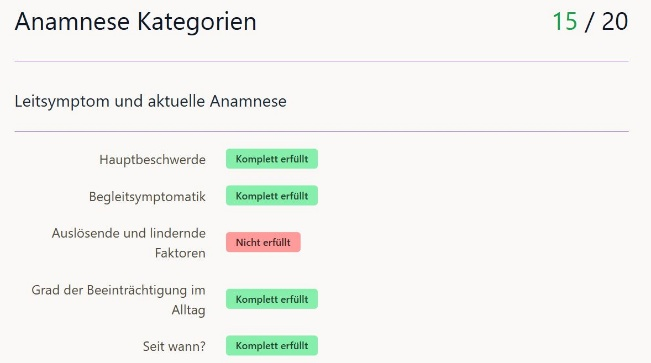
General/Internal Medicine History Taking [2]
Condition-Specific History Taking
Hypomania, Alcohol use disorder, Borderline personality disorder, Agoraphobia, Panic disorder.
Disorder-Specific History Taking (Depression): Diagnosis and Severity Classification [3]
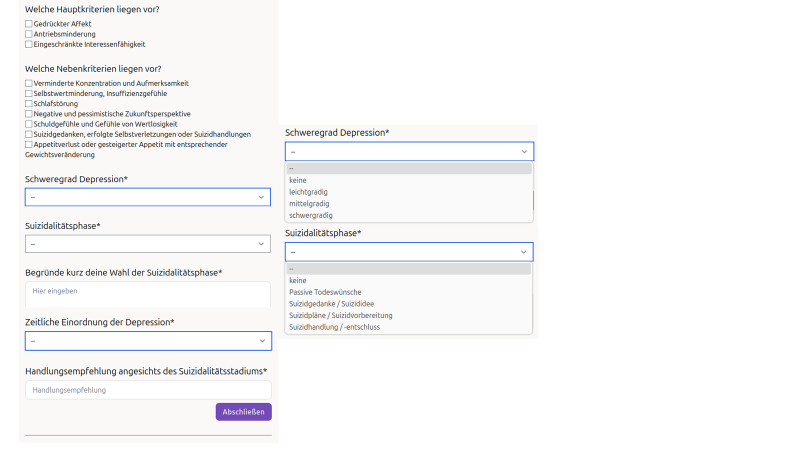
Psychopathological Assessment (not yet published)
SBAR: Interprofessional Handover Protocol (not yet published)
Pipeline based on a human expectation framework for structured clinical handovers.
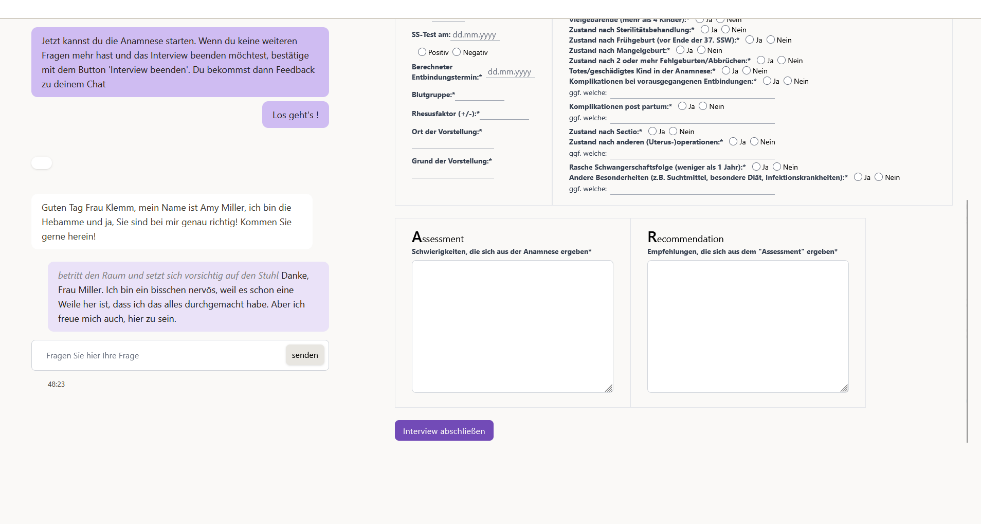
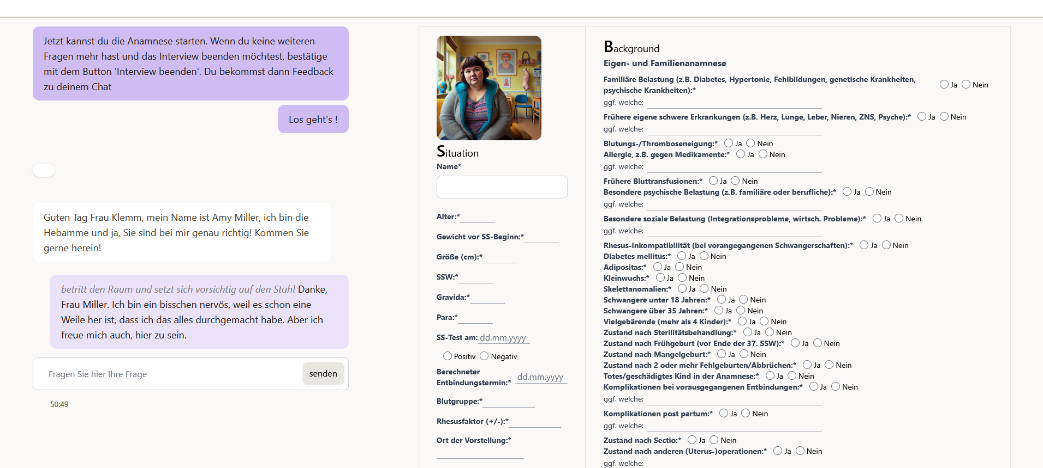
Maternity Record Documentation (Medical History) (not yet published)
Evaluates the documentation of medical history in the maternity record.
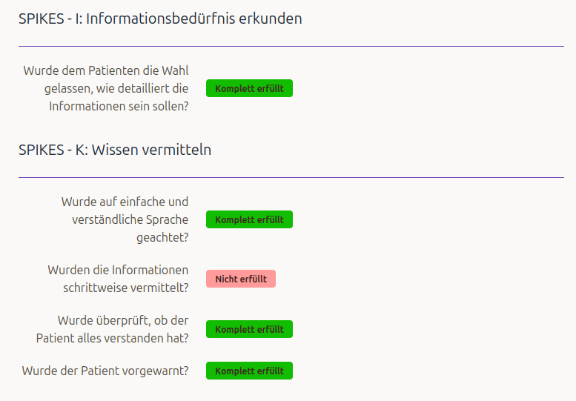
SPIKES: Delivering Bad News (not yet published)
In Development
Shared Decision Making - conversation structure
OPTION - Shared Decision Making evaluation
And more
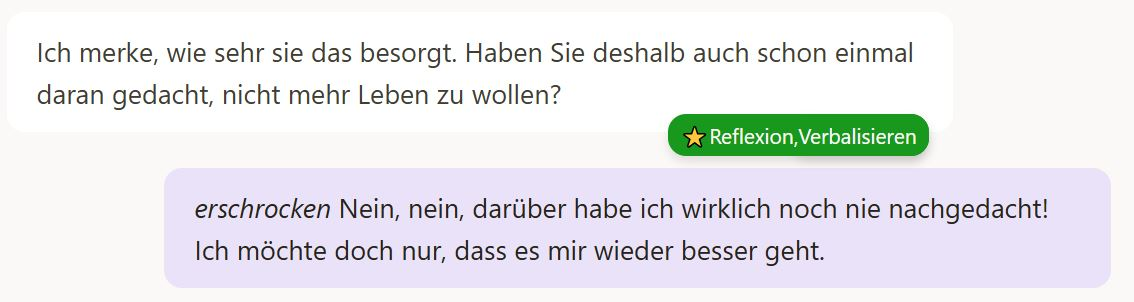
Live-Feedback [4]#
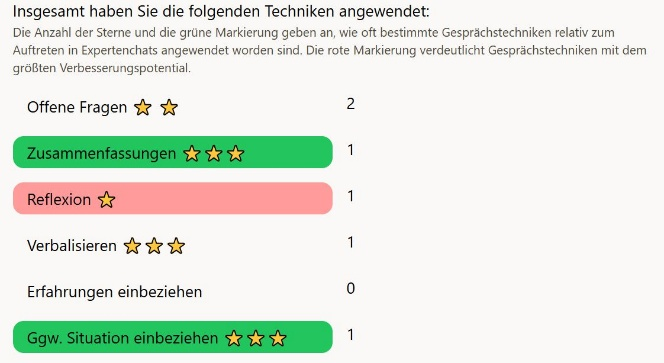
Communication Techniques
NURSE (live)
WWSZ (live)
Empathic communication according to Rogers (text-based feedback)
Interventions (conversation-based)
Motivational Interviewing / DBT (live)
Real-Time Documentation
SORKC (behavioral analysis)
In Pilot Phase
Additional applications currently under development.